Here's a link to a critique I wrote in response to the report and recommendations of the Theological Education Advisory Council (TEAC) of the ELCA. It was published in the Summer 2016 issue of Lutheran Forum and takes TEAC to task for issuing a document that veers from our theological tradition and doesn't solve the urgent crisis in ministry before the church.
This writing style is distinctly different from what I do in my preaching. The article is a polemic and stands in a strong Lutheran tradition of theological arguments that goes back to Luther himself.
The Babylonian Captivity Redux
Thursday, June 9, 2016


Wednesday, June 8, 2016
We're Dead. We Don't Need No Stinkin' Credentials!

This sermon, preached on June 4-5, 2016, continues a series based on Galatians at St. James Lutheran Church, Johnston, Iowa, while their pastor is on a spiritual pilgrimage on the Camino de Santiago de Campostela in northern Spain. It's based on both Galatians and the gospel reading from Luke about the raising of the dead son of the widow in Nain.
This week I was talking to Ryan Cosgrove, a former student of mine
who’s now serving as a pastor in Burlington. While I’m an old professor cut off
from the ins and outs of weekly preaching, Ryan is a millennial connected to all
kinds of social media preaching sites and participates in a pastors’ text study
each week. We were talking about today’s reading from Galatians, and he said
that he was surprise that the other pastors and posters on social media had
declared this passage about Paul’s authority to be pretty thin gruel for
preaching. They thought it was inconsequential and boring, with nothing much
going on. “I went into the regions of Syria and Cilicia, blah, blah, blah. But
this passage is deceptive in its mundaneness. It’s actually an incredibly big
and important part of Paul’s argument in the letter. And it falls right in line
with the rest of what Paul is talking about in Galatians.
Remember from last week that Paul had been a Jewish
religious lawyer, a Pharisee, and he had persecuted Jesus’ followers – even to
the point of helping out at the stoning of Stephen, the first Christian martyr.
When Paul came to faith with his encounter with the risen Jesus on the road to
Damascus, he also became the church’s greatest missionary and most important
theologian. He’d gotten permission from the believers in Jerusalem to go tell
non-Jews out in the Roman empire about Jesus. He’d already been to the region
of Galatia, which would be central Turkey today. Now, as he’s moved on to
preach Christ in other places, a group of Jewish Christians has arrived from
Jerusalem to investigate, and they’re shocked that Paul hadn’t taught the
Galatians to follow Jewish religious laws like Jesus, the disciples, and they
themselves do. They demand that the Galatian men who had been pagans now submit
to the ritual of circumcision and have what we’ll call “their former life”
sliced away. Paul says what the Jewish Christians have been saying is a false
gospel, that is, their demands don’t give Christ’s benefits freely. He says
that to stake your salvation on something you do, even something as good as
circumcision is for Jewish males, takes Christ out of the salvation equation.
Because Paul preached in the Galatian communities and
the Spirit brought people to faith through his preaching, in order to undercut
Paul’s work there the Jewish Christians called his authority into question. They
wanted to know what exactly Paul’s credentials were. That seems like a
reasonable request to us. When Grand View’s education majors want to become teachers,
the Iowa Board of Educational Examiners establishes requirements for their
curriculum. For instance, you don’t get to become a fifth grade teacher if you
haven’t taken a class about educating a diverse set of learners. Our nursing
majors have to pass a rigorous battery of tests called the NCLEX in order to be
certified to serve. The Iowa Bar Association won’t accept you for membership,
no matter how good your law school grades if you don’t pass the bar exam. Each
profession has specific requirements, and the church’s pastors do, too: You
have to have a Master of Divinity degree or its equivalent, and you have to
meet the requirements of the ELCA’s “Visions and Expectations” document, which
details sexual behavior guidelines, financial guidelines, lifestyle and other
qualities of a faithful pastor.
Article XIV of the Augsburg Confession, the Lutheran
church’s primary guiding document from the 16th century, says no one
may function as one of the church’s public proclaimers (that is, as a pastor)
without a regular call. Even if you feel an internal call to ministry, in the
Lutheran church you don’t get to take up a position in a congregation without
the church setting you apart as a pastor. Our brothers and sisters in the Lutheran Church-Missouri Synod is
going to take up the issue in its national convention in Milwaukee this summer.
They’ll ask if it’s kosher for the church to license lay people to administer
the Lord’s Supper or if only pastor should be allowed to do it. When it comes
to Paul and Galatians, though, it’s a whole other matter. The Jewish Christians
want Paul to have checked off all their required boxes: be Jewish, be circumcised,
be a disciple of Jesus or authorized by one.
But for Paul, it’s not about adhering to a set of
credentials. He was called by the risen Jesus himself. When Paul was still a
bounty hunter tracking down the blasphemous followers of Jesus, he was riding a
horse on the road to Damascus 138 miles away in order to make some arrests.
Suddenly there was a blinding light, and Paul was knocked to the ground and struck
blind. He heard the voice of the risen Jesus ask him why he was persecuting the
Lord. And he was told to get himself to the home of one of the believers. In
that moment, everything changed for Paul. He began to see Jesus’ appearance to
him as the dividing line between his old life in sin and death and his new life
taken up in faith in the Lord’s resurrection.
When the Jerusalem Christians who’ve shown up in
Galatia demand Paul’s credentials as proof that he’s allowed to tell these
converts that they don’t have to follow Jewish law, Paul’s response is, “Credentials?
I don’t need no stinkin’ credentials!” That’s because for Paul saving faith is
all about a relationship with Jesus. It’s what was established for Paul on the
road to Damascus. Paul cares about other questions: Has Jesus made you his own?
Has the word grabbed hold of you to give you faith? Has the water been poured
over you and the promise proclaimed to you in baptism? Has Christ given himself
to you with the promise of forgiveness in the Lord’s Supper? Has God announced
forgiveness to you on account of Jesus’? In each of these ways, you’ve had the
same experience as Paul: Christ established a relationship with you through no
work of your own. So Paul basically says, “Credentials? Ain’t got none. I only
have Jesus. And if you have a problem with the Spirit having moved a former
persecutor of the church like me to preach to the gentiles, you’re going to
have to take it up with Christ. You claim to have such good standing with God
on account of your adherence to religious laws. Go ahead and trot that out
before God as evidence of your worthiness. See how well that works out for
you.”
In last Sunday’s gospel we heard the story of the
centurion who asked Jesus to heal his servant and came to confess his own
unworthiness and Christ’s great power and authority. Today we come up against
another character who’s even less worthy: the dead son of the widow from Nain. By
what worthiness or authority did the dead young man come to be raised? He was
dead. He had nothing to bring before God’s judgment seat. What’s worse, anyone
who came close to his dead body and funeral bier would have been regarded as
unclean and unrighteous. People would have to stay away from them for a week
lest they, too, become unclean.
But Jesus seems to care not at all about clean and
unclean, righteous and unrighteous. Becoming unclean and being cast out of the
community for a week seems to be a trifle for him. And it doesn’t matter to him
that the dead young man can’t present credentials for worthiness. In fact,
Jesus has the dead guy right where he wants him: lying there unable to move,
unable to perform a good work, unable to defend himself, unable to take a
breath and puff himself up in pride. The guy is dead, and that’s not just good
enough for Jesus, it’s the only thing for him.
At that point, there’s no longer any hope for action,
neither a little finger twitching to indicate the guy wanted to be raised or
asking the Lord to come into his life or giving his heart to God. Dead fingers
can’t twitch. Dead people can’t catch a breath in order to speak. And this
guy’s heart just isn’t beating anymore. The only thing you can say the dead guy
is able to do is rot. And even that is about as passive as you can get. The
dead son of Nain is simply done with life. He has no more he can do. Now it’s
Jesus’ own power and authority to raise him from the dead or nothing at all.
Paul pretty much tells the Galatians that his favorite
t-shirt says, “Resurrection from the dead: been there, had that done to me.” That’s
what happened to Paul on the road to Damascus. Jesus grabbed him, and Paul saw
that the life he’d led was actually corrupted and rotting from the inside. Paul
was as dead in sin as the son of Nain was lying on his bier. The presence of the
risen Christ may have knocked him to the ground, but it also raised him to new
life.
So once again, we have the same story we had last
Sunday when we began to hear about the distinction between what is Christ and
what is Not-Christ. Paul’s opponents want to point to his lack of credentials
as a problem. But Paul knows that credentials are Not-Christ. When Jesus is the
only game in town for Paul, to submit to legalistic credentialing is to deny
Christ. And it’s a false gospel every bit as much as the demand that the men of
Galatia unzip and be circumcised.
To turn to something that is not Christ seems like
it’s just adding a small thing. It’s just a bit of foreskin. It’s just a
diploma. It’s a mere exam. It’s simply a class to take. It’s just a decision for
Christ. But what Paul’s opponents don’t see, and what he wants the Galatians to
open their eyes to, is that adding even the smallest thing is to diminish what
Christ has done on the cross and to make him less than Lord of all. Is it
Christ who saves or not? If you submit to a demand to be more religious, a
better Bible reader, less of a sinner, a more devoted Christian, a stronger
fighter for peace and justice, then you have made yourself the hinge of
salvation. And what we’re going to hear later in Galatians is that when you’ve
allowed that camel’s nose under the tent, it will take over everything, and you
will lose freedom and salvation.
When the demand for credentials and proof of authority
comes, Paul says he’s unqualified. The only credential he has is the same the
dead son in Nain bore: he was dead in sin, and the only life he has is the one
Christ gives him. Can anything less be true for you? As Paul says in Romans,
while we still were sinners Christ died for us. You who have been baptized into
his death are now raised in his resurrection.
When Luther’s prince, Frederick the Wise, died in 1525
after having stood by his local professor and pastor even in the face of the
power of the Holy Roman Empire and the condemnation of the church, the reformer
preached at the prince’s funeral. He called Frederick’s death the little death.
His body was done moving and breathing, and, yes, the people were right to
grieve. But Luther said Frederick died the big death, the point when he was
loosed from the world’s powers and freed in Christ, when the prince defending
the gospel that Luther preached. Luther told the gathered mourners that it was
Frederick’s confession of faith via his actions when he died and new life began
for him.
It’s a strange thing when that happens to you. You
never actually realize you were lying on your bier, traveling through the world
dead as nails and unable to move. And yet now by the power of God’s word
declared to you, your eyes are opened and, blinking, you think, “Wait! What
just happened to me? How did I get here? Wow!” As long as you’re alive enough
to hold a credential in your hand, you’re not dead enough for Jesus’
resurrection. Besides, he doesn’t want those papers cluttering up the divine
ticket-to-heaven counter. His death was messy enough. He doesn’t need that from
you. Keep your good works and use them for your neighbors.
And when your little death comes, and you, too are
physically over and done with and of no more earthly good, save as worm fodder,
then lie still, because Jesus has a word he’s going to speak to you. He will
come to you with sweet somethings for your ears, saying, “Get up. Enjoy the new
eternal life I’m giving you starting right now.” You’ll no doubt open your eyes
and blink. But you shouldn’t be surprised. Paul has been telling you about it for
two thousand years. And he’s announcing it to you again today. Jesus is the
only credential you need and the best portable defibrillator around. There’s a
new heartbeat, a new life, and a new calling as one of Christ’s own that have
been place in you.
Next week get ready because we’re going to come
face-to-face with a legal equation that declares your fight to maintain your
current death in sin to be over. Of course, it’ll be more of the same, but
Paul’s going to take us ever deeper into it. Amen.
Tuesday, June 7, 2016
True Gospel, False Gospel
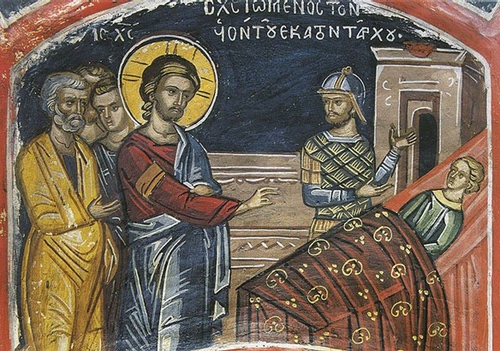
This sermon from May 28-29, 2016, begins a series on Galatians preached at St. James Lutheran Church, Johnston, Iowa, while their pastor is on sabbatical doing a spiritual pilgrimage on the Camino de Santiago de Campostela in northern Spain. It is based on both the Galatians passage and the story of the healing of the centurion's servant in Luke 7.
In our second reading today, we begin a series of
six weeks when we get to hear Paul’s letter to the believers in Galatia. As we
move through it in the next weeks, there’s one thing you should listen for. In
the letter, Paul makes a distinction between Christ and not-Christ, that is,
between Jesus – the one who has the power and authority to save you – and
everything else in all of creation (even the best of it), none of which has an
ounce of power to right what’s wrong between us and God.
In today’s section of the letter, Paul is spitting
nails because the Galatians have been manipulated by Jewish Christians from
Jerusalem. Those Christians had grown up as Jews, and their entire lives they’d
followed all the religious laws. Now, when Paul had been granted permission to
go out into the pagan world and bring people the gospel there, these Jewish
Christians waited until Paul continued to other places on his missionary
journey, and they had come to Galatia to check on things.
What they found there
shocked them: The new believers there weren’t following Jewish religious laws from
places in the Old Testament like Leviticus. That means the Galatians weren’t
worried about not eating pork or shrimp, not wearing two different fabrics, and
not getting tattoos. The big problem, though, was there were foreskins aplenty
among the Galatians, and the Jewish Christians knew that circumcision was the
thing you needed above all others to identify yourself as one of God’s chosen
people. Paul’s opponents from Jerusalem
have told the Galatian men that, in order to become true, full Christians, they
had to follow Jewish laws just like Jesus did. And that meant they needed to
lift their tunics and submit to circumcision.
For Paul, who trusted that Jesus had done everything
needed for his own salvation as a Jew and for the salvation of non-Jews like
the believer in Galatia, that signaled a blurring of the lines between what
saves you and what doesn’t. For Paul, demanding that someone do something in
order to be identified as Christ’s own, meant you had displaced Christ as
savior and grabbed onto something else. Even the very best things, including
circumcision for a good Jewish boy like Paul, become false gods if you look to
them to save you. That’s why in the letter today Paul says the Galatians have
been bewitched and glommed onto a false gospel. For Paul, as we’ll see a couple
Sundays from now, the only thing that matters in your salvation is that you
trust Christ to accomplish it. The actual language he uses is that we’re
“justified by faith.”
God’s word keeps the distinction between Christ and Not-Christ clear. There in the word God promises you that Jesus, and Jesus
alone, has the power to deliver you from sin, death, and the devil, and that he
does it without any effort, strength, or understanding on your part. Old Nick,
the devil himself, seeks to have you abandon that promise in Christ and look
elsewhere. He prefers that you disregard God’s word and keep it sequestered on
a bookshelf or, better yet, away from your house.
If you’d be so bold as to
open up God’s word to find Christ’s promise, then the devil will get you to put
yourself and your religious activity and devotion forward as the be-all and
end-all of your salvation. Look how great and pious you are! And then he’ll
twist you into worrying that now you’re in trouble because you’re selfishly
thinking about yourself and haven’t come to God’s word with the proper
attitude. And before you know it, your eyes are scanning paragraphs without
ever really finding Christ, because once again you’ve concentrated on something
other than what the Lord has done for you. Just about the time you think you’ve
begun trusting Christ, you realize instead that you’ve been trusting only your
own ability to trust and need to start all over again.
If you even get that far, then the Tempter will
bring in his next trick to get you to trust something that is not-Christ. This
bit of skulduggery involves turning the promises of God’s word into shady
little demands and petty legalism. He aims to take your eye away from the
promises of Jesus’ death and resurrection and, like the Jewish Christians
plaguing the folks in Galatia, he has you latch on to Moses and the
Commandments as your savior and the way to life eternal. The devil comes under
the guise of piety and cloaks this temptation to faithlessness in seemingly good-sounding
propositions. He would have you concentrate on your advancing your religious
progress, on the quality of your commitment, on the level of your giving, on
the number of people in the pews next to you, on the number of commandments any
of us has kept or broken. The Evil One may even get you to engage in spiritual
exercise and pious activities like opening your Bible for daily devotions. But
if he does, watch out, because he wants to make even those things and your very
faith as well into the objects of your trust instead of Jesus Christ, God’s Son
who died for you on the cross.
It’s a dilemma for all us sinful humans. How can we
possibly escape our cycle of trusting ourselves rather than Jesus? How can we
turn away from our own power, desire, and will? How can we keep from the real
danger of succumbing to a false gospel, especially one that presents us with so
many seemingly good and God-pleasing things to do? How might we, instead, as
Paul bids the Galatians, begin to trust our Lord and his gracious promise.
In our Gospel reading, Luke provides a picture of
faithful trust as he gives us the story of the healing of the centurion’s
slave. Instead of trusting something other than Jesus, the centurion clings to
the one true gospel in his demand to Jesus to just do something, anything, to
help his servant back home. It all begins fairly well on the centurion’s part.
He’s got a highly-valued slave who’s lying on the welcome mat of death’s door.
And the centurion does exactly what he ought to do: He hears about Jesus and
goes to put it all in the Lord’s hands. Now that’s good and faithful start.
Scripture tells us to seek after the Lord. Luther says we ought to approach God
with complete confidence, just as children speak to a loving father. So here
the centurion confidently sends a couple of Jesus’ own Jewish elders out to
talk to him.
So far so good. But watch how that old sinful self
immediately gets in the way and trips any truly faithful gesture by the
centurion. What’s the message that the centurion sends to Jesus? The elders
start talking about worthiness, just like the Jewish Christian would do years
later with the Galatians. They come up with a list of all the centurion’s good
deeds for God and country. Although he’s a soldier in an occupying army, he
loves the people under his command. And although he’s another pagan Roman, he’s
even seen to the religious life of the community by building a synagogue in
Capernaum. Jesus must have had a good chuckle to himself as they rattled off
this list of the centurion’s good deeds, because Jesus knows he doesn’t give a
whit for the centurion’s goodness or righteousness. He’s not out to shape up
the world or even show off the centurion as a fine example. For Jesus, the only
worthiness that matters is his own, and he’s about to prove it. For the time
being he lets the messengers and the centurion keep their illusions, and he
heads out of the soldier’s quarters.
Now comes the turning point of the story. Now comes
the repentance. Now comes the centurion’s eyes opening up in faith to the true
gospel rather than the sham gospel that’s been going down up to this point. But
if you want to see the repentance, you have to look closely, because our gospel
writer Luke keeps it between the lines. The closer Jesus moves to the centurion
the harder it is for the soldier to keep on his mask of worthiness. (Notice,
too, that it’s Jesus doing the moving, not the centurion. That’s how Jesus
works, you know.) The nearer Jesus gets to the center of the centurion’s life,
the more clearly the soldier sees the truth about his own life, the more
clearly he sees that scope of Jesus’ power, the more clearly he sees his place
within that power and authority.
The centurion can’t bear it anymore. He sends out
some of his buddies from the NCO club to talk to Jesus this time. He sends a
different kind of message, and in it he begins to make the distinction between
what is Christ and what is not-Christ. And he starts to tell the truth. He
says, “Jesus, don’t bother coming out to me. That was the wrong message when I
sent those elders over to kiss up to you. I have to tell you the truth: I’m not
worthy to have you step across my doorstep.” But it’s two steps forward and one
step back as the old sinful self in him moves in again to try to give excuses.
The centurion says, “Oh, yeah, that’s also why I didn’t come out to you
myself.” But finally the presence of Jesus does its work. From the centurion
come the most faithful words in the whole story. He says, “Jesus speak the
word, and let my servant be healed.”
Let’s stop and think about that. Now, as he’s
brought up short in his worthiness quotient, not only has the centurion figured
out that none of this has to do with his own worthiness, but he also knows
Jesus has something else he wants to do and how the power to get it done. Now
there is faith in the centurion’s heart moving him to speak. What faith asks
for is for Jesus himself to do what he says he’s come for. Faith trusts that
Jesus’ word has power all to itself, without adding the centurion’s worthiness,
without some effort on the part of the dying slave, and without the snipping of
foreskins or any other commendable religious activity in Galatia.
Without anything else in heaven or on earth, Jesus’
speaking will get done what he seeks to accomplish. And it’s this asking Jesus
to speak and waiting attentively to hear something good that Jesus holds up as
faith, greater faith even than all the religious, very religious people among
God’s chosen people in Israel, including the folks form Jerusalem who’ve cooked
up a salvation scheme for the Galatians. Lo and behold, the servant is healed,
and Jesus heads off to the village of Nain to raise form the dead a widow’s
dead son who has even less chance of doing some good deed for salvation than
the centurion and his servant. Next Sunday you’ll see Luke pushing Paul’s same
point to its ultimate, amazing end: The best place to be saved is when you’re
dead and don’t have a chance to present any good works to God.
But here today, Luke tells of the centurion’s trust
in a word from Jesus and the word’s power all unto itself. Paul wants us to
escape our cycle of trusting ourselves. How can the Galatians and we begin to
trust our Lord and his gracious promises? Luke shows you how it happens as he
fleshes out the promises of God’s word in the gospel reading. The end of your
sinful self begins with Jesus’ presence moving in through your life. He likes
to do that, you know, move in and through your life. He does this with the Holy
Spirit who calls us and gathers us in. As the Spirit opens our eyes to see
Jesus more and more clearly, we see our own unworthiness. We see how paltry our
goodness is and how week our strength to save ourselves is. But we also see
Jesus’ own worthiness, his goodness and all-encompassing grace, his mighty
strength to bear what you can’t and save what the world regards as hopeless.
We hear that powerful promise that for your sake Jesus died, that you might be spare the punishment God
gives to unworthy sinners. As Jesus comes to you in the water and the word in
baptism, in the bread, wine, and proclamation of the Lord’s Supper, in the
preaching of the good news, and in his story in scripture, he seeks to make
that promise work inside you. Jesus is working to separate himself from all
other competitors in the salvation game. He’s opening your eyes to the
distinction between what is Christ and what is Not-Christ. He’s working to put
these words on your lips: “Speak the word, Lord, and let me be healed.” For to
trust in the word is to seek after the true speaking of the word, rather than
to look to the NutraSweet imitation of a false gospel of morality and ethics,
spiritual exercises and pious activity.
To trust in Christ is to go face-to-face with Jesus.
It means looking him in the eye and saying, “Come on, Jesus. I’ve got nothing
left to lose. Give me what you have. Nothing else can do the trick. I want you.
Bring it on, Lord.” Next October we’ll begin a year-long celebration of the 500th
anniversary of the Reformation that began with Martin Luther’s posting of the
Ninety-Five Theses. In one treatise that Luther wrote, he talked about the
special thing that God allows the baptized to do. He said that not only does
your baptism confer on you deliverance from sin, death, and the devil, it also
gives you permission to make demands on God. If God has promised you abundant
life in Christ and you’re seeing the fruit of that promise, you get to go
mano-a-mano with God and demand the abundant life.
That’s an approach that sees Paul’s distinction
between a true and false gospel clearly. It knows who it is that bestows life,
goodness, grace, and peace. It knows those things don’t come from things you
do. They don’t come from whipping yourself into a religious frenzy. They don’t
arrive with a stack of good deeds that you can present before the judgment seat
of God. What God wants for you comes only from the one who healed the
centurion’s slave. Telling Jesus to bring it on is the ultimate act of faith.
Go ahead. Try that kind of boldness on for size and then tell the religious law
keepers to take their false gospel put it somewhere where the Son don’t shine
(that’s Son with a capital S and an o in the middle). Repeat after me: “Just
bring it, Jesus. You’ve got it. You want to give it to me. I want it. I need
it. Bring it Lord. Bring your promised life. Bring your promised forgiveness.
Bring your promised salvation. Raise me from the dead, and number me as your
own.” Amen.
Monday, June 6, 2016
A Good Man, Full of the Spirit

This sermon was preached at a monthly Communion service at Scottish Rite Park, a senior living apartment tower in Des Moines, Iowa, on May 12, 2016
Acts
11:19-26
"Now
those who had been scattered by the persecution that broke out when Stephen was
killed traveled as far as Phoenicia,
Cyprus and Antioch, spreading the word
only among Jews. Some of them,
however, men from Cyprus and Cyrene, went to Antioch and began to speak to
Greeks also, telling them the good news about the Lord Jesus.
The Lord’s hand was with them, and a great number of
people believed and turned to the Lord.
"News
of this reached the church in Jerusalem, and they sent Barnabas to Antioch. When he arrived and
saw what the grace of God had done, he was glad and encouraged them all to
remain true to the Lord with all their hearts. He was a good man,
full of the Holy Spirit and faith, and a
great number of people were brought to the Lord.
"Then
Barnabas went to Tarsus to look for Saul, and when he found
him, he brought him to Antioch. So for a whole year Barnabas and Saul met with
the church and taught great numbers of people. The disciples were called
Christians first at Antioch."
Pentecost is this Sunday. We celebrate the birth of
the church with the story of the coming of the Holy Spirit to the disciples,
Peter’s preaching, and thousands of people who come to believe. This story from
Acts this morning is an extension of what happened there.
Saul, whom we later come to know as Paul, has had
his encounter with the risen Jesus on the road to Damascus. When he tries to
join the disciples they reject him because they don’t trust him. After all, he
was one of the persecutors of the believers and when Stephen was stoned he held
the cloaks of those who slung the rocks But Barnabas knows differently. He
looks at Paul with different eyes.
Acts says Barnabas was “a good man, full of the Holy
Spirit and faith.” When he went to Antioch, God used the good news he brought
to create faith in a great number of people. Barnabas had no fear of Saul. He
goes after him with relentlessness. Like the photographic negative of Saul
persecuting Christians, Barnabas pulled Saul into the circle and spent a year
teaching him what Christ had done. In effect Barnabas was a one-man seminary.
The scriptures are full of stories of people who are
full of the Spirit. It didn’t just happen after the miracle at Pentecost. Time
after time in the Old Testament, God calls people to become judges, prophets,
and preachers. The scriptures say “the spirit of the Lord came upon them.” We
tend to think it’s some mystical experience these people had. But it’s both
simpler and deeper than that.
When the scriptures talk about the Spirit it has to
do with being connected to God’s Word. When God created the heavens and the
earth, God did it with the Word. John, of course, reminds us that Jesus himself
is the embodiment of God Word. To be full of the Spirit is to be full of God’s
Word, to be full of what Jesus, the Living Word, came to give.
For Barnabas to be full of the Spirit is to be full
of faith, rich in his understanding of his own sin and Christ’s deliverance and
redemption. It means he’s overflowing with a mercy that can see even the worst
enemy of the church with gracious eyes. In Galatians, Paul tells us what being
full of the Spirit looks like. “The fruit of the Spirit is love, joy, peace,
patience, kindness, goodness, faithfulness, gentleness, self-control.” If you
call yourself a Christian and use your religion as a cudgel to bludgeon your
enemies – even real enemies – then your store of the Holy Spirit is wanting.
As we come up on Pentecost on Sunday, we ought to
pray for that Spirit to bring us such faith that we can go to the Tarsus of
this day and age to bring those at odds with God into his loving circle. That
can happen in all sorts of places, including here at Scottish Rite Park. It
means turning to our neighbors with love and patience. It means bringing mercy
and living mercy for others. It means being one like Peter at Pentecost, who
didn’t put himself in the limelight but instead pointed to Christ as the source
of his life, joy, and hope.
You, too, have been called by the Spirit in your
baptism. You were joined to the Word that created the world. You are grafted
into Christ’s death and resurrection. You will go where he has gone and receive
what your heavenly bridegroom brought you: his life, his name, and his place at
God’s right hand. Hear this good news today. Let this Word flow into your ears
and fill you with the Holy Spirit. Amen.
Monday, April 18, 2016
God for the Skeptic: Christianity Is Not a Straitjacket

This sermon was preached March 10, 2016, for chapel at Grand View University as part of a series aimed at skeptics, doubters, wonderers, sinners, and seekers.
Grace to you and peace, my friends,
from God our Father and our Lord and Savior Jesus Christ. Amen.
Let me say it straight out: I don’t
want to be bound by anything. I want my boundaries limitless. I don’t want
anything to stop me, hinder me, or throw a wrench in my affairs. And when God
demands that he will be God and I must remain human, fallible, and perishable,
I react as if someone is coming after me with a straitjacket, buckles waving in
the air, sleeves ready to bind me, and a locked and padded cell awaiting me. I
fear that being a Christian will imprison me. Like St. Augustine, I pray, “God
grant me chastity, but not yet. Grant me religious fervor, but not if people
will think I’m weird. Grant me a clean heart, but let me giggle at something
smutty now and then. God, give me a future, but let it be on my own terms. And
keep that damn straitjacket of religion far away.”
I’m a skeptic, there’s no doubt
about that. I know how the world works. An eye for an eye and a tooth for a
tooth. There’s no free lunch. You get what you pay for. You need to look out
for number one. And this business of God being God? It’s for fools and children
and doormats. At best we’ll chafe against our fetters. At worst we’ll wind up
like good king Zedekiah’s in the book of Jeremiah. The Babylonian enemies
defeated his armies. They killed his sons. They plucked out both his eyes. They
bound him in chains and threw him in prison for the rest of his life. I’m not
willing to go there.
I’m skeptical, that’s for sure. But
what’s it ever done for me? All my skepticism is is a way to defend myself.
It’s what we human beings have always been after from the time our parents ate
the apple in the Garden of Eden and throughout history. When the serpent said
to Eve, “Did God really say you would die,” it was the tug into
skepticism. And it’s the first move of
someone like me who wants to save his own backside. I have to be a skeptic of
anything and anyone else. I have to, because I know that I’m the only one I can
trust. I’m afraid of anything that might hinder my freedom. That straitjacket
is the epitome of my fears. My biggest fear is anything that might keep me from
reaching for what I desire – for good or ill. The truth is that my bondage is
far worse than a straitjacket, because I can’t even honestly admit what’s got
me all tied up in my life. I’m like Isaac in the Old Testament, but without
ever knowing the end of the story.
In Genesis, God had promised Abraham
and Sarah in their childless old age a son, an heir, and countless descendants.
When it wasn’t happening, they took matters into their own hands and had
Abraham sleep with their slave Hagar. She bore a son named Ishmael, but that
son of slavery wasn’t the free son God had promised. Finally, when Abraham and
Sarah trust and waited upon the Lord’s favor, Sarah bore the boy Isaac. He
became the apple of their eye, the focus of their days, and the source of their
life. When he was twelve, God told Abraham to take Isaac up the mountain and
kill him as a sacrifice. So Abraham grabbed Isaac and a bundle of wood and
trudge up the mountain. At the top, he placed the kindling and logs on a rock
and then turned to his boy. He took Isaac’s hands and wrapped them in sturdy
cords, tying them in strong knots. He did the same think with his son’s legs.
And he lay the kid on top of the pile. He drew a sharp knife from its sheath
and raised it above his boy’s chest. When it comes down to it, we think God is
going to treat us like Abraham treats his own son. We think God is going to end
things. We’ll be sacrificed to religion. We’ll be given over to the death of
our autonomy. We can’t imagine any other way out, so we will not allow
ourselves to be led up that mountain.
But God will not leave us either to
our fears or the skepticism they hide behind. God goes against his own binding.
God goes against his own demands that you be held to a godly standard. Instead,
God seeks to free you. At the very moment Isaac was about to lose his life, God
provided a lamb to slaughter and sacrifice instead of Abraham’s son. The knife
that the father raised to kill the boy became the very instrument used to cut
the ropes that bound him. And Isaac went down the mountain with a prize: He
held a new wool pelt under his arm that he could wrap up in when the nights
grew dark and the days grew cold. The lamb God provided was for him – not just
on the mountain but throughout his life.
If you’re scared that Christianity
will take your power, autonomy, and freedom away from you, then know this: You
never had any power or control in the first place. Your navel is proof of that.
You didn’t come into this world by your own will, and it’s worked the same
every day since. Christianity is no straitjacket out to bind you, because
you’ve been sacrificed for and now have ultimate freedom – a kind of freedom
you could only hope for against your wildest imagining. Christianity isn’t some
nanny wagging a scolding finger at you and restricting all your fun.
Christianity is a sharp knife to slice through your fetters. It says, “Yup.
You’re free. Wrap up in the skin of the Lamb of God and then look around you.
What do you want to do with all your freedom? Whom might you love, given that
you’re released from having to think about yourself until it makes you sick?”
We get scared of anything that might
hinder our freedom. But here’s the deal: You have a savior in Christ Jesus who
came to free you all the way. As Paul says in our scripture reading tonight,
“For freedom Christ has set us free. Stand firm, therefore, and do not submit
again to a yoke of slavery.” Don’t let yourself start thinking that you have to
be the one to make everything in your life come ‘round right. The Lord has your
freedom so firmly in hand that you can actually start praying against your
autonomy, your independence, your imagined freedom. In the Lord’s Prayer we
pray against those things when we say, “Hallowed be thy name. Thy kingdom come.
Thy will be done.” There we pray that God would deliver us not only from evil
but from ourselves, and then we ask God to deliver the real good in our daily
bread. We pray, “Free me Lord by bringing a lamb.”
And that’s just where we’re headed on a couple weeks
on Good Friday when we hear about the God who would dare subject Jesus, the Son
of God, to our skepticism, to our unwillingness to belief, and to our demand
that he be killed so we can stay independent and autonomous. Then we’ll hear again
about a God who suffers to the bitter end the tragic consequences of our fear
of the straitjacket. If you fear a straitjacket, prepare yourself to hear of a
God who allows himself to be bound in the worst place possible. He allows
himself to be put in the one place you’ll never be able to free yourself from:
the grave.
And when you hear this good news, then will come
even more. You will know the end of the story. You have a God who will not stay
strapped and buckled and bound by death. Like some divine Harry Houdini, Christ
bursts forth. In his resurrection he grabs what belongs to him. He reaches for
every one of us who is caught and bound by life’s circumstances: by cancer, by
sorrow, by schedules and bills, by loss and grief. He shreds that straitjacket
and turns you to face the light streaming into your tomb. Then you will come to
know freedom that comes from a God who turns from his own demands to make your
salvation come, not from what you can do for God, but from what God has done
for you.
Is it possible that you’re actually free? Yes. On
the cross, Christ made it happen. You can breathe easy. The struggling, the
beating yourself up, the banging your head against the wall to make your future
happen – it’s all over. Now all you have is this: Jesus wrapped around you in
your darkest night and coldest day, Jesus your light and salvation taking you
into your new free citizenship in the kingdom of God. Thanks be to God. Amen.
Wednesday, February 17, 2016
The Advocate and the Advocates

We have three ELCA colleges in Iowa (five, if you count the two Augustanas at our northwest and southeast corners), and this morning you sit not two miles from the one that only the Danes and Des Moinesians know about. So I bring you greetings from the other ELCA school, Grand View University. If you use E. 14th Street as your route into or out of the city on your travels today, you’ll find yourself in the middle of a healthy and vibrant college that revels in its Danish Grundtvigian tradition of seeing to it that an education is accessible to all. If you’re people who care for justice in the world, and you are, then you should find a place for Grand View in your hearts.
You’re in town today to put your faith to work in advocating for your neighbors or, if you’re a legislator, in opening your ears to your fellow sojourners in the faith. Whether you are the mouth or the ear in the body of Christ today, though, you’re in great danger of slipping into unfaith. For as soon as you are aware of your good intentions, your highly ethical motives, or your being on the right side of the scales of justice, then the Old Eve and Old Adam in you raise their heads out of the baptismal pool and find reason to bray about their accomplishments. We are at the gate leading to holding up our own holy name, our will, and our vision for the kingdom, rather than praying that God’s name be hallowed, that God’s will be done, and that God’s kingdom come. The problem with caring so deeply that you’re willing to take a stand, is that you might just be wrong and, even if you’re right, your rightness may very well lead you into the realm of pride and other great and shameful sins. So although it’s with a hard word that I begin today, there will yet be plenty of good and gracious news to come.
Late in his life, when his collected works in Latin began to be published, Martin Luther had the opportunity in that 16th century version of his “Greatest Hits” to look back on all that had happened in what we’ve come to call the Reformation. In that autobiographical snippet Luther said it didn’t begin with the Ninety-Five Theses and the fight against indulgences that we’ll celebrate with next year’s Luther jubilee. Instead, Luther took his readers back to his time as a friar when he’d been taught the visible works that would make for justice and righteousness in the world and before God. Luther would come to distrust both his own ability to do what is just, right, meet, and salutary and the entire system that assumed it had the market on righteousness cornered.
We can see it at work in Luther’s lectures on Romans a couple years before the explosion of the Theses. Luther would get to his classroom each morning ready to begin his lecture at 6:00 a.m. (a time which allows me to brook no complaining from students in eight o’clock classes). His notes were written on pages of the printed biblical text with wide spacing and generous margins. He moved through Romans verse by verse. Right away we can see Luther questioning anything that looked like a plan for justice or righteousness, either in the world or in the church. He became dubious of anything that sought progress toward goodness through virtuous actions.
By the time of Luther’s predecessor Saint Thomas Aquinas in the 13th century, theology had become thoroughly steeped in the thinking of Aristotle, the philosopher of Greece’s Golden Age. Aristotle argued that all human actions and ideas are aimed at what is good. Doctors want good health. Bridle-makers want good control of your horse. And we, of course, want good living conditions and good opportunity for all people in Iowa. Aristotle’s stance was that we advance toward goodness on a route from vice to virtue. We choose to act virtuously, we do good in the world, and we avoid the bad. Our philosophical friend said that we won’t ever achieve complete goodness, but we’re always on our way. Our life needs to be one that makes a habit of virtue.
I’ve decided to learn a piano piece this semester. I had a year of lessons in sixth grade and about three weeks in college. I’ve basically taught myself to play, but I’m not satisfied with my ability. I don’t even have a single piece memorized. So I’ve decided that I’m going to learn a piece so well that I can sit down at any piano without music and play it. I’ve chosen Robert Schumann’s lovely little piece “Träumerei.” I’m fortunate that the Theology and Philosophy Department is housed in the same building as the Music Department with all its studios and practice rooms. Every day when I get to my office, I grab my single page of music and walk across the atrium to the piano studio. There I sit down at a Steinway and play through my piece three times. I’m getting really good, but I’m still reliant on the music. I want to get to the point where I no longer have to think about the notes and simply play. That’s what Aristotle aimed for in his discussion of ethics and virtue. We ought to practice what is virtuous so that we no longer have to think about the ins and outs of goodness, but we’ll simply do the right thing. And we’ll get better and better and better. Every day. In every way. It’ll be a movement of progress into a better world than existed in our unenlightened, unvirtuous past.
That’s a way of thinking that the church picked up and ran with like a Denver Broncos running back, and it’s deeply embedded in the ethos of the American way. We see ourselves as progressing to the better if not to the fully good. We strive to pull ourselves up by our own ethical bootstraps. We set ourselves up as individual cities on the hill, shining out with the virtue of our own light. By Luther’s day, the church in which he’d been reared had an entire structure built on engaging in the virtues of its sacramental practices. Even though it pushed Luther to come to a position directly counter to it theologically, it also opened up a critique that extended to all our projects to create what is just and right in the world. In contrast to Aristotle and all the Christian theologians who were influenced by his thinking, Luther would come to argue that you don’t become good by doing good works. Instead God alone makes you good by freeing you with the gospel. Luther likened people of faith to good trees that automatically bear good fruit without thinking whether they ought to or not. (More on that in a bit.)
The very first day of Luther’s lecturing on Romans, he went on the attack. Here’s how he began: “The chief purpose of [Paul’s letter to the Romans] is to break down, to pluck up, and to destroy all the wisdom and righteousness of the flesh. This includes all the works which in the eyes of people or even in our own eyes may be great works.” What Luther was getting at is what lies at the core of what we’ll be celebrating in the coming year-long jubilee. For Luther, Christ is the one, the only one, who brings salvation and who ushers in the acceptable and eternal year of jubilee when the poor, the cast down, and the disconsolate are given succor, when justice rains down like water, and when sinners’ robes are washed in his blood. If Jesus is the way, the truth, and the life, if it is his cross by which the world’s stripes are healed, then all other comers must be rejected.
In short, for Luther, your good works and valued contributions to a better Iowa on behalf of your neighbors can’t have any bearing on your salvation. Luther was well aware of how the works of the flesh Paul lists in Galatians keep us from entering the kingdom of God. But in his Romans commentary and throughout the next 31 years of Luther’s life and career – even to his final written words, “We are beggars” – Luther showed us that being good religious boys and girls is just as likely to land us in God’s condemnation as being spiritual truants and delinquents will. So Luther in Romans rejected the path of our spiritual journey from vice to virtue. Bad deeds show our rejection of God and our fall away from Eden. But reliance on our good deeds is, for Luther, an equal rejection of God, for there, too, we have no need of Christ, self-reliant and holy and just that we are. So Luther argued that what God seeks instead is “an exodus from virtues to the grace of Christ.”
In the City Church in Wittenberg, Germany, you can find an altarpiece painted by Luther’s friend Lucas Cranach. The top three panels depict baptism, the Lord’s Supper, and the Office of the Keys, that is, the announcement of forgiveness to those who repent of their sins. The panel beneath those three, though, shows a congregation at worship on the left listening to the preacher in a pulpit on the right. The preacher is Luther, and standing between him and his congregation is Christ on the cross with a white cloth symbolizing the Resurrection floating in the air around him. If you have a smart phone you can Google “Wittenberg altarpiece” right now and see a picture. Lucas Cranach understood what Luther was after. For Luther, Christ is all in all. Christ is the one who brings in God’s gracious rule on the cross and whose Resurrection seals the deal. All Luther has to do is point to Christ, forsaking everything else that presents itself as something that can save us.
This is exactly what Paul is up to in his Galatians letter. When Paul says we are justified by faith apart from works of the law, he’s setting up two categories. There’s Jesus Christ who saves, and there’s everything else that doesn’t save – even the best, most virtuous and just things we can think of. When you have that down, you will discover endless freedom. Paul urges the Galatians to cling to that when he says, “For freedom Christ has set us free. Do not submit again to a yoke of slavery.” All of which is fine, except for the fact that we’re here today to do what I regard as truly important, virtuous, and good works. You’ve been called to love your neighbors as yourself, for crying out loud. And you’re champing at the bit to do that important advocating.
Each semester in my “Christian Faith and Life” course, I require students to form groups to plan and implement a service project. At the same time, they have to read Galatians and Luther’s treatise on Christian freedom. In their final papers they have to deal with the same question before us: If our good works like their service projects have no bearing whatsoever on our salvation, then why would anyone ever fight for justice, to house the homeless, to feed the hungry, to garner living wages for the poor? Will we only do that if we’ve got a whip snapping at our withers? Will college students only do good works if a professor demands it of them in order to merit a good grade in the course? Will human beings only care for their neighbors if it gets them in the pearly gates and out of the fire and brimstone of the devil’s realm?
In “Freedom of a Christian,” five years after his Romans lectures, Luther held up the one thing that makes it all work: the Word of God. This gospel word has come to you. I know this because, one, you’re here listening to me, for only the faithful would subject themselves to a mid-morning lecture when they could be having coffee at Scenic Route Bakery two blocks away, and, two, you actually have hearts for this business of caring for your neighbors. At Grand View University we like to make a distinction between an education based on transaction and one that arises from transformation. You can see college as a transaction in which you put in your time and effort and in turn receive a good grade. You parlay that and all your other courses into college transcript and a degree and engage in another transaction where you trade it for a job. Which leads you to trade your time and effort in a job for a salary and benefits, which in turn gets traded for a suburban home and riding lawnmower along with an end to school loan payments when you’re 70. That’s a lot of transacting, and it all starts with seeing college as the first in a pearly string of transactions that extends to our graves.
But what college is really about is a transformation. I teach one of our first-year seminars, and have had the same batch of 20 freshmen in class all school year. And I see the transformation at work in them already. And it has little to do with the grade they’ve received on their latest lab report, paper, or test. We don’t take freshmen and move them from the vice of being unschooled and unaware of important facts and figures. Instead, in relationships with their peers, with professors and staff, and with countless thinkers that have emerged over the ages in human history, they grow in their understanding of their relationship to ideas, to thinkers, to the world’s structures, to empires, to the oppressed and downtrodden and disenfranchised, and, of course, to God. Luther used the word “conscience” for this awareness of your relationships with those around you. I’d argue that what we do at Grand View is to grow consciences bent on engagement with the world. And because we’re a college of the church, we’re privileged to also give witness to the gospel that quells troubled consciences with Christ’s mercy and calls students into lives of service as God’s hands at work.
Lutherans on the Hill is a day of transformation. It’s not a tit-for-tat lobbying effort. It happens because you yourselves have been transformed by the gospel. And speaking to one another about these matters of import is what the reformers called “the mutual conversation and consolation of the saints.” When you go to the Capitol for those conversations, you are revealing how you’ve been transformed. You’re showing that you’ve heard God’s word. You’re showing that your eyes have been opened; the scales have fallen away to be able to see your neighbor’s need. The Holy Spirit, whom John’s gospel calls “The Advocate,” has brought you to such faith that your life has begun to take the shape of the cross. It has made you sympathetic, literally sharing suffering with another. Your transformation at the behest of the Spirit to work faith when and where it wills extends Christ’s transformation of the world beyond the dictatorship of the self out into the world.
That’s how the Holy Spirit has operated since the day of Pentecost. Whenever people of God have attempted to enclose themselves in a safe circle, the Spirit has broken it open. It happened to Peter and the disciples that day in Jerusalem, to Lydia and Dorcas, Augustine and Monica, Abelard and Heloise, Martin Luther and Martin Luther King. The Spirit will not rest though you be idle. Even now, Paul reminds us, we are being made anew, fit for worship and service.
The language we use to talk about this centers around the word “vocation.” This language verges on a gnostic secret that we Lutherans seem leery to speak of and whose contrasting picture of the Christian life we’re reluctant to let the world in on. What we’re up to in educating our students at Grand View and what you as the church are here to do today is vocation. This doctrine of vocation that was near and dear to Luther is too little heralded in Lutheran circles and much less in the wider world. Although good works like advocacy aren’t a criterion for salvation, they are an essential element of the Christian life.
In “Freedom of a Christian,” Luther asserted that Christians do good works for two reasons. The first is your neighbor’s need. The poor and dispossessed, the homeless and hungry, as well as less exotic folk like your children, your aging parents, your fellow drivers on I-80, and the SOB down the street whose dumpster tipped over in the wind, all need your good works. God uses your actions to make the world safe, secure, orderly, just, and fair. You’re going to wind up with a howling newborn if there’s no diaper change and feeding at 2:00 a.m. You’ll drive through a neighborhood strewn with biodegrading recyclables if you don’t gather up what’s tipped out of the dumpster. You’ll have an underclass crying out for justice if you don’t see to it that issues of equality, opportunity, and wealth aren’t addressed. The Advocate has empowered you with the will and the words that make a difference today. Your faithful participation in the democracy is salt, leaven, and light.
The other reason Luther said we do good works is to control the flesh. He doesn’t mean that our souls are good but our bodies are bad. Instead he’s using Paul’s distinction between the spirit and the flesh, that is, between our God-given trust in Christ and our eternally sinful desire to justify ourselves and work to our own benefit. If you can’t accomplish salvation and have to leave it to your Lord on the cross, you can, however, have quite a hand in God’s work of restricting the sinful half of simul iustus et peccator, the “simultaneously saint and sinner” description Luther labeled us with. As my students might say, we do good works because it sucks to do them. The Old Sinner in us hates to do good works like you’re up to today.
When I ask my students to do a service project, I always tell them about a Catholic boys high school in Cleveland, Ohio. A small group of boys who’d been challenged to do works of charity as people of faith decided they would serve as pallbearers for the indigent and for those in need, for people who’d died without any family or friends around. They called themselves the Arimathea Society after Joseph of Arimathea whose tomb Jesus was buried in. And now they have about two hundred guys in tan pants and blue blazers who honor their neighbors by carrying them to their graves. That’s a mighty act of faith, yet though I praise it to heck and back not a single group of my students has ever been willing to come close to anything as frightening as graves and dead bodies. They can’t bring themselves to do it, but think of the transformation if they did.
I, for one, am an everlasting introvert, and to think about button-holing a legislator I don’t personally know to talk about an issue vital to my neighbor’s interest is a nightmare scenario. But when faith happens in me, I begin to see how the sinner in me is what lies beneath my reluctance, and, given what Christ has done for me on the cross, I don’t want my sinful nature to gain the upper hand. So I do counter-intuitive counter-introverted stuff like talking to strangers, like naming the truth about society’s ills, like speaking the name of Christ in a world that doesn’t want to hear it.
Now everything I’ve said is well and good, but there’s one more thing to think about today. It has to do with Jesus’ parable of the sheep and the goats in Matthew 25. You know the one: the Son of Man comes in glory and separates his sheep from his goats. To the sheep he says, “I was hungry and you fed me. I was naked and you clothed me. I was bereft of music and you gave me an iTunes gift card. Etc. Etc.” The goats, though, get a declaration that they did no such thing. Both the sheep and the goats are dumbfounded. They say, “When, Lord? When did that happen?” Here’s the thing: If you made a decision to come to Des Moines for Lutheran Day on the Hill today, then you’re not quite at the sheeply spot where the Lord wants you to be yet. When Jesus calls the disciples in the gospels by saying, “Follow me,” not a single evangelist says the disciples sat down to make a rational faith-based decision. They simply dropped their nets, put down their tax-collection account records, left their families, and went after the one who had called them. You’re on your way, to be sure, but God is even now making you into someone who doesn’t even need to think about your neighbor’s needs or about curtailing the fleshly sinful side of you.
God is already creating a new you that bears the fruit of the Spirit: love, joy, peace, patience, kindness, generosity, faithfulness, gentleness, and self-control. In Galatians Paul says these things need no law to tell you to do them. And I’d add that they need no rational thinking either. Christ calls you to your vocations without thought or intention. The Advocate is remaking you into little advocates who bring the gospel to bear in the world with no goodness aforethought. And the way it happens is exactly how Luther said it does – by means of the gospel. If you’re to work freely in the world, you simply need to be freed. So let me do what I’m called to do as one of the church’s public proclaimers. Let me give you the word that the Advocate reshapes, revives, and resurrects you with: For Christ’s sake you are forgiven. With no contribution of your own, our Lord has you tucked into his spear wound to bear you into eternity with him. On Jesus’ account, there’s nothing that can separate you from the love of God. You’re free. Hey, look! There’s a neighbor in need. And over there there’s a legislator. Let’s see what kinds of advocates you’ve been made to be right here and right now.
Tuesday, October 13, 2015
Borders, Boundaries, and the Ethiopian Eunuch

This sermon was preach at chapel at Grand View University on October 13, 2015, and is based on the story of Philip and the Ethiopian Eunuch in Acts 8:26-40.
It’s
Global Vision Week at Grand View University, so it’s appropriate to consider
how that vision moves us to think beyond the limits of borders and boundaries.
What links us? How do we work together? How might our differences actually bind
us one to another rather than separate us? The passage from Acts we just read
together goes after those very questions as we enter into an encounter in
border lands and meet a guy, who through no fault of his own, has found himself
on the wrong side of some very strict boundaries.
The book
of Acts is the second of a two-volume work. Both Acts and its partner book, the
gospel of Luke, are careful to mark out geography. When you’re reading them you
always know where you are, whether within the borders of Judea where Jewish
religious laws and demands for purity are at play or outside Judea where you’re
sure to meet up with someone impure, strange, foreign, or undocumented person.
Our story today takes place right on the line between what a good Jew like Philip
would think of as territory of good people and territory of dangerous, unclean
sinners.
Even
Philip’s presence down in Gaza between Judea and Egypt was an interruption and
marks a crossing of boundaries for him. He’d been doing the Lord’s work
preaching way up north and having some success. But both an angel and God’s
Spirit drew him down to this netherworld between clean and unclean, Jew and
pagan, righteous and unrighteous.
There in
front of him was a chariot. It was no plain two-wheeled cart pulled by a mule.
No, this was clearly the vehicle of someone important: fine horses, emblazoned
with gold, and wheels that were true and so obviously crafted by the best of
wheelwrights. The chariot’s driver was a servant of the Queen of Ethiopia, a
position of high responsibility. He had to guard the queen’s treasury and
account for every last gold coin.
The
Ethiopian’s personal ethics weren’t the only thing that made him a trustworthy
man to serve as treasurer. When he was a boy, they also made sure that he’d be even
more trustworthy by slicing open his junk and removing his testicles. The fancy
word for that is castration, and a guy that’s had that happen to him is a
eunuch.
During my
college days, there was a bar in my university’s town that set itself apart
from other drinking joints by advertising itself as a place to play pool. There
were around twenty pool tables there, and shooting pool was how you occupied
you time while drinking your bad Miller Lite’s. The bar’s ads in our school
newspaper had an interesting tag line that read, “You gotta have balls to shoot
here.” That was not true of the Ethiopian treasury. A fully-equipped package
wasn’t going to help you keep your job in the queen’s counting house, because
you’d always stand the chance your sexual drives would result in some sexual
impropriety for which you could be blackmailed. And then there would go the
realm’s fiscal security.
When
Philip met the eunuch, the charioteer was heading back home to Ethiopia from
Jerusalem, the capital city of Judea and the holy city of the Jews. That’s
where the Jewish Temple was, and the Ethiopian had gone there to worship and
make some offering at the Temple. But when he got there he basically heard the
same line tossed out by my college pool joint: “You gotta have balls to shoot
here.” The officials there knew it as soon as he opened his mouth to ask a
question and they heard his high voice that never changed at puberty due to a
lack of testosterone. The law in Deuteronomy was clear on this count: “No one who has been emasculated by crushing or cutting may enter the
assembly of the Lord.”
So this
faithful man was on his way home rejected by the officials of the foreign faith
he’d risked everything to take on. A black Jewish man from the upper reaches of
the Nile would have been a huge anomaly. And here he was in front of Philip, digging
into the scriptures and refusing to let the rejection keep him from the God
he’d come to trust. As the chariot wheels rolled, he had his hands on a scroll
of the prophet Isaiah. Right then Philip knew everything he needed to know: The
guy was castrated and, thus, unclean. But he was also open to what God is up
to, just like the people who’d heard Philip’s preaching up north and come to
faith before.
The
Ethiopian asked Philip to help him understand what he read. It’s like faith
always happens. Although we may have some inkling of God’s existence, what’s
really needed is a proclaimer of the gospel. It’s what Paul says in Romans,
“Faith comes by hearing.” The Ethiopian needed a preacher to proclaim to him
who Jesus is.” The angel and the Spirit seem to have known a castrated
treasurer would be kept from worshiping and would need to hear the gospel, and
they’d sent Philip to Gaza.
Hearing
everything Philip had told him about Jesus, now our African castrato knew
everything he needed to know. Jesus was for him, as unlikely as it seemed.
Jesus had died and was resurrected so he might have Christ’s benefits. But
there was one thing he didn’t know. He’d been told in Jerusalem that a man who
shows up to worship but isn’t the complete package needn’t bother. The
Ethiopian knew that at least two things prevented him from entering the Temple,
or at least the lack of two things did.
So he
asked Philip, “Here’s some water. What is there to prevent me from being
baptized?” It’s as if he expected Philip to say, “Well, I can tell by your high
voice that you’re testicularly-impaired. You have to have balls to shoot here.”
But the Ethiopian discovers to his great surprise and joy that, when it comes
to salvation, our God discards his divine playbook, throws out all the rules
about who’s supposed to be in and who’s supposed to be out. In Christ, God
breaks his own law to claim people like the eunuch who have no hope.
The
Ethiopian who carried the equivalent of an empty grocery bag with him at all
times found himself filled with new life. Not only was his emptiness and lack
no longer an impediment. It actually became a gift. This guy couldn’t depend on
being whole and in tact on his own terms or with his own power. He knew it was
nuts to expect anything but rejection, but he was brought in and considered
whole on account of what Christ, the lamb slaughtered, did for him.
If you were to do what AA calls a fearless and searching moral inventory, you’d surely come
across something in you that prevents you from that full and abundant life God
promises you. It might be some sin, some lack of talent or drive, a low
mid-term grade, or even an inability to assent to the proposition that God
actually exists. But our reading declares the end of all that rule-keeping,
record-bolstering, accounting of unclean versus clean, righteous versus
unrighteous, in versus out.
Instead
what you have is a God who respects no borders or boundaries and who seeks out
those who haven’t got the cojones to
make it on their own. This is a God who says to you, “There’s a font, and there’s
nothing to prevent you from being baptized. Here’s my only-begotten Son.
There’s nothing to prevent you from enjoying the gifts of salvation, mercy, and
eternal life that he has to give you.”
If you
haven’t got that, I know a pastor who’s ready to have a conversation with you.
What’s more, for those of you who already claim those gifts, our passage from
Acts is a bid to open your eyes to begin looking at those around you in this
world in a way that takes you beyond your own borders and boundaries and see
them as your neighbors. It calls you to listen for those who are on the outside
and welcome them in as your own, even as God brought in an Ethiopian eunuch who
had no business expecting anything good from God.
And if
you’re scandalized or offended by all this talk of genitalia, certain that I’ve
crossed a line and spoken of something unfitting for a church pulpit, now you’ve
landed on something important. And there’s a word for you as well. For our Lord
who knew no sin became sin for us. Jesus
himself was accused and tried, crucified and died, all because the proper religious
people who knew what the boundaries of propriety were regarded our Lord as
having crossed the line. Oh, my friends, be not offended, but be glad and
grateful that Christ made himself an offense, so that he could take on your
sin. If God-in-the-flesh does not scandalously break the borders of propriety
and polite spiritual company, then we’re all to be pitied and the Spirit has
been rendered impotent.
The truth
is that God will brook no boundaries when it comes to seeking you out and
claiming you. You don’t need testicles or anything else to be in: no grades, no
record of yardage on the football field, no high RBI numbers, no national
championship. The only thing needed is nothing. The eunuch had nothing in a
certain bodily location, but God filled him full of every good thing. And those
things are yours as well. Amen.
Subscribe to:
Posts (Atom)